To start off with: YES, I AM AWARE THERE IS A FILM VERSION OF THIS BOOK! ^^
You wouldn't believe how many people asked me if I knew of the film with Sean Connery while I was reading the novel - either because they loved it that much or because they wanted to spare me the supposed agony of reading the book. It got to be quite funny, actually - and not only because the film was probably a huge part of my motivation for picking up the novel in the first place. Apparently, Eco has quite the reputation for being an unreadable author, especially for his book Foucault's Pendulum.
Luckily, however, I had at least three big motivators for picking up this novel and getting to the end of it: 1) the magnificent film, 2) the lovely teacher-student bond, 3) the truly great lecture on the postmodern elements of the book by Albert Meier.
As a result, I think I got about half-way through the novel, before I began to feel the strain of ploughing through all the descriptions - and then it wasn't too difficult to keep going, since the plot had already begun unravelling. But speaking of plot ...
Since I wanted to broaden my literary horizon a bit, I recently read Things Fall Apart by the Nigerian author Chinua Achebe. To be honest, I didn't love it from the start, since the narrative style and the literary world was quite unfamiliar - it was very hard to get into at first. However, about a quarter into the book I really fell in love with it, partly because it was so unfamiliar, I think. It was really refreshening to take a break from the issues of European societies in various periods, and instead visit a very different culture in a different country. Before I expand on that, though, I should probably tell you what this book was about in the first place.
Summary
Things Fall Apart is a novel which tells the story of Okonkwo, a very successful inhabitant of Umuofia, a village in the territory which is now known as Nigeria. Despite his success, Okonkwo's life is dominated by his fear of becoming like his father, who was a drunkard badly in debt to all his neighbours. This fear is his ultimate flaw, as it makes him the terror of his own family, particularly when he believes they are showing signs of "weakness". There are countless instances when his fear makes him become violent to the point of beating up his own wife or hitting his children. Violence, it seems, is the only way he knows how to triumph over perceived "weakness".
For the majority of the novel, Achebe describes the way of life in an Igbo village pre-colonialisation. The reader gains insight into Igbo tradition and custom, which are not always painted in a positive light (e.g. the abandonment of twins in the wild). Simultaneously, we also get to know Okonkwo's fatal flaw, namely that he will do anything to avoid being weak and remain respected in his village.
Even thouh things already start falling apart for Okonkwo, things get really critical for him when the white man arrives in the midst of the community and starts trying to convert the Igbo people to the Christian faith. It doesn't happen overnight, but gradually a split develops between those villagers who turn to the new faith and those who decide to stick with their own gods and beliefs. Eventually, both the villagers and Okonkwo realise that the world will never be the same again ...
For those of you who like to watch videos, here's Shmoop's really entertaining summary of the novel. Be careful for major spoiler's though!
Right, now that that's out of the way, let's start talking about some of the fascinating things about this novel!
Language
So, the first thing that was so surprising for me about this book was that it was originally written in English, and not in one of the many languages of Nigeria (more than 500!). The author himself gives a very important reason for this though, namely that precisely because of the multitude of languages spoken by the people of Nigeria, it was necessary to use English, as this was the only way to reach as many Nigerians as possible. Nigeria used to be a colony of the British Empire, that's why English is such a wide-spread language even today (next to the obvious English-as-a-global-language phenomenon, of course).
However, just because he used English does not mean that Achebe did not put his personal touch on the language in order to reflect the culture he aimed to describe. In fact, he apparently once said that writers of African origin "should aim to fashioning out an English which is at once universal and able to carry his peculiar experience" (Source). In order to accomplish that in his own novels, he wove together a text which is filled with Igbo words, phrases and proverbs. All throughout the novel, the reader encounters words like harmattan (a dry, sandy wind, typical for the region), chi (a god/karma/fate, personal to every villager), or ogbanje (a special kind of evil spirit), next to the obviously foreign words for plants, food and culture-specific objects.
Harmattan
I also enjoyed the proverbs a lot, such as "A toad does not run in the daytime for nothing", meaning that strange things do not happen for no reason at all, and, most famously, "Proverbs are the palm-oil with which words are eaten".
For honesty's sake though, I have to admit that it was exactly these words, phrases and proverbs which made it difficult to get into the novel at first, because sometimes I just had no clue what Achebe was talking about. However, the deeper I got into the story, the more I started appreciating their inclusion, until in the end I couldn't get enough of them. I think that Achebe was a hundred percent right in using these Igbo words and phrases, because next to the obvious advantage of giving you a bit of an insight into the language the protagonists in this book are really speaking, some things just cannot be readily translated into a foreign language. It's the same nowadays, when people choose to use German words instead of English ones, for instance, because they express certain concepts better (e.g. schadenfreude for the kind of malicious glee you feel when something bad happens to another person). At the end of reading this book, I'm very glad for these words and phrases, to the point where I've even taken a look at a website on the Igbo language :). Something interesting I discovered over there: Igbo is actually a tone language like Chinese, which means that, depending on the pitch you use when pronouncing a word, it could mean something totally different!
Impact of the novel
Achebe has been called as the father or patriarch of the modern African literature, partly because his first novel Things Fall Apart had such a world-wide impact. It was published in 1958, at a time when (brace yourselves) only six other novels by African writers had been published in the West. Isn't that amazing? Things Fall Apart stands at the beginning of a huge effort to reinvigorate African literature - an effort that was further supported by Achebe by serving as advisory editor to the African Writers Series published by Heinemann (according to wikipedia there are nearly 300 titles in this series now - I'll have to check that out, it sounds amazing!).
It wasn't only - or even primarily - an attempt to make African literature appear on the literary radar of the West. Things Fall Apart was also an effort at reconnecting with the culture of Nigerian people before they were colonised and became part of the British Empire and all that entailed - British education, British administration, British religion, etc. This was especially important at the time, as Ghana had just become independent, and Nigeria gained independence from the British Empire only two years later in 1960. People obviously felt a need to re-examine their past and find a new identity.
The novel, however, wasn't just about telling a story in which the original customs and tradition are portrayed as good vs. the evilness of the colonisers. Achebe worked really hard at painting an ambiguous picture, where there is good and evil on both sides. For instance, the first converts to Christianity in the story are exactly those people who were disadvantaged by the old customs and traditions or thought there was something wrong with them - those people who were branded as outcasts or those who didn't believe in the practice of abandoning babies in the wild just because they were born as twins. Similarly, the first Christian missionary who arrives in the village of Umuofia is actually accepted by the villagers and is even allowed to eat with the elders. It is only the second missionary, who comes after the first one falls ill, who is the typical bad guy most of us know from films.
It's quite fascinating, really, the way that this story both changed African literature and the way books by African writers are viewed all over the world - and I love it all the more for it.
Finding one's own voice
This sort of ties in with both of the points above: one thing that was particularly important to Achebe was to tell the story of African history and culture in a new way, namely one that would be truer than the sort of stories Europeans wrote about Africa, in which Africans of whichever country where either portrayed as savages or as innocent (but stupid) children. Achebe had a particularly big beef with Joseph Conrad who, in his view, outed himself as a "thoroughgoing racist" (Source) in Heart of Darkness. His main evidence for that accusation was that Africans, in Conrad's novel, are hardly capable of speech. There are only two instances in which they are allowed to pronounce actual words, the rest of the time they babble and grunt, such as in the quotes that Achebe uses:
In place of speech they made "a violent babble of uncouth
sounds." They "exchanged short grunting phrases" even among
themselves. But most of the time they were too busy with their
frenzy. (Source)
Furthermore, he argues that Africa in European literature in general has always been portrayed as more primitive and backwards - "uncivilised" - in order to boost European's self-confidence. A fact which reveals itself to devastating effect in Heart of Darkness.
Thus, Achebe wrote Things Fall Apart to tell another kind of story, one in which African people appear as fully-formed human beings, capable of both emotions and language, who encounter other fully-formed human beings, equally, but not more, capable of these things. And it works out brilliantly.
Western ignorance gone mad
Finally, I thought I'd share with you all the things I've found out about Nigeria over the last week, since my curiosity was peaked upon finishing the book. I even made a tiny slide about it to make it look pretty:
So, things I shamefully had no clue about: Nigeria acually has a population of over 182 million people. 182 million. That makes it the most populated country in Africa and the seventh most populated in the world! There are also over 500 different ethnic groups living within the borders of Nigeria - borders which, by the way, were only drawn (somewhat arbitrarily) by the British.
Of course these 500 different ethnic groups also have 500 different languages, which is why Achebe was right, I think, in thinking that it would be best to write in a language which would transcend the various first languages of the Nigerian people.
The Igbo people, by the way, are the third biggest ethnic group in the country. They live in the southwestern region (the light-brownish space on the map), where the vegetation ranges from tall-grass savannas to rain forests.
There was a civil war in Nigeria from 1967-1970. Nigeria had gained independence from the British Empire in 1960, but the post-colonial period was anything but an easy ride. The Igbo people in particular seem to have felt that they needed to establish their own sovereign territory, which is why they tried to establish the Republic of Biafra. Eventually, they were defeated, however, and after much suffering (about which Achebe wrote poetry, by the way) they were reintegrated into Nigeria.
After Goodluck Jonathan, the current president of Nigeria is Muhammadu Buhari. He led a military coup in the eighties, which brought him into office for a couple of years, but in 2014 he was democratically elected. According to wikipedia, he has called himself a "converted democrat" (Source).
And finally, as a chilling example of how western societies used to view Africa: at the time of publication of the novel, in the late 50s to early 60s, people in NYC could go and look at African cultures in general in the Natural History Museum - you know, right next to the polar bears ... O_O.
Final verdict
I really loved the novel. I loved the language, the different customs, the fascinating way of life, the complexity of Okonkwo's character, the ambiguity of good and evil - and if you've been able to plough on through the entirety of this entry, then I'm sure you'll love it, too ;).
Achebe, C. (1977) An Image of Africa: Racism in Conrad's Heart of Darkness. Massachusett's Review [Online] 18. Available from: http://kirbyk.net/hod/image.of.africa.html.
So, I finished reading Huckleberry Finn almost a week ago now, and if I'm totally honest, I still have no clue what I think about it exactly. To be clear: there are a lot of bits which I really loved, and I'm going to show some of them to you later on. Equally though, there was quite a bit of stuff that I did not enjoy at all - first and foremost the glaring use of the n-word throughout the book. So let's get right to that to have it out of the way.
Racism in Huckleberry Finn
So, I get that this book was written at a very specific point in time and that Mark Twain probably chose to include the n-word for authenticity reasons, among others ... but that didn't and doesn't make it any easier for me to read it. And that's on the one hand because I only recently saw Selma, and on the other because of reports by students such as this one:
I can still recall the anger I felt as my white classmates read aloud the word "nigger". In fact, as I write this letter I am getting angry all over again. I wanted to sink into my seat. Some of the whites snickered, others giggled. I can recall nothing of the literary merits of this work that you term "the greatest of all American novels". I only recall the sense of relief I felt when I would flip ahead a few pages and see the word "nigger" would not be read that hour.- Allen B. Ballard (Letter to the Editor, NYT, 1982)
It's just such a painful, nasty term - and encountering it in this novel which is supposed to be one of the greats obviously hurts and makes me feel uncomfortable.
So, I really had no clue how to deal with this until I found this segment of The Daily Show in which Larry Wilmore makes some truly excellent points about the use of the n-word and why it needs to stay in the book, despite attempts to have it removed:
For me, the most important point that Larry Wilmore makes (and it's almost drowned out) is this: the word is supposed to make you feel uncomfortable. I think all evidence points to the fact that Mark Twain chose to use the n-word for a reason, which was to contrast the savagery of the white people who would use it with the loyalty, intelligence and good-heartedness of Jim and other black people. This comes through most clearly in the drunken tirade of Huck's father, in which he truly reveals himself to be the mean-spirited, evil person that he is:
There was a free nigger there from Ohio - a mulatter, most as white as a white man. He had the whitest shirt on you ever see, too .... They said he was a p'fessor in a college, and could talk all kinds of languages, and knowed everything. And that ain't the wust. They said he could VOTE when he was at home. Well, that let me out. Thinks I, what is the country a-coming to? It was 'lection day, and I was just about to go and vote myself if I warn't too drunk to there; but when they told me there was a State in this country where they'd let that nigger vote, I drawed out. I says I'll never vote agin .... And to see the cool way of that nigger - why, he wouldn't a give me the road if I hadn't shoved him out o' the way. I says to the people, why ain't this nigger put up at auction and sold? - that's what I want to know. And what do you reckon they said? Why, they said he couldn't be sold till he'd been in the State six months.- Adventures of Huckleberry Finn, Ch. 6
It's ironic, isn't it? A drunk failure of a man who has no pleasure in life except to make his own son's existence miserable has the audacity to slur against another, obviously well-educated man, just because of his skin colour. It's the epitome of superficiality and only emphasises the stupidity of Huck's father.
So, even though I still feel hugely uncomfortable reading this word, I've now sort of come to terms with why it's important that it stays in the book. I suppose, in the end, it's like a mirror to the past: it shows us what we once were and what we must never return to. And with that in mind it would be wrong to cleanse the book of it and thereby change history just because it offends our sensibilities now.
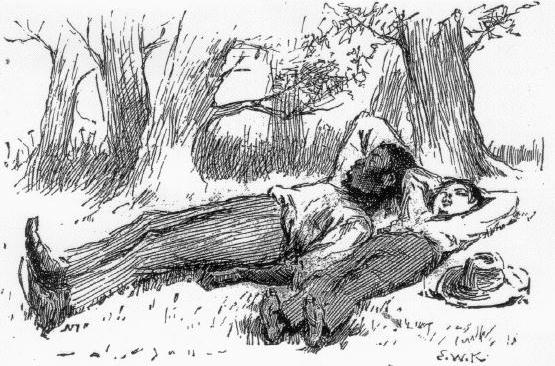
With regard to Huck Finn documenting the history of slavery, there are a couple of other interesting things hidden away in the novel, such as this picture by the official illustrator of the novel:
Jim and Huck (E. W. Kemble)
What's interesting about this picture, as the people working on the Mark Twain Project have pointed out, is that it directly quotes another picture, which was used in the campaign to abolish slavery:
(c) New York Public Library
Apparently, in order to raise awareness about the evil of slavery, this image was printed onto pamphlets, stationary and even goods such as pottery. I don't know about you, but I have to admit I find stuff like that fascinating - and I'm glad there are people out there researching this, because I would've had no clue otherwise.
Superstitionin Huckleberry Finn
What's also fascinating, historically speaking, are all the different superstitions that are infused into the novel: like the belief that you can cure a rattle-snake bite by drinking lots of whisky. This happens near the beginning of the book when poor Jim is bitten by one of these snakes (because of Huck's stupidity, frankly) and the first thing he does is grab a jug of whisky. He also asks Huck to cut off the dead snake's rattles and tie them around his wrists, since that is supposed to help too. There are loads of other superstitions in the novel too - about spiders and witches and hairballs, funnily enough. It's a lot of fun, really!
Regarding the thing about the snake, again with the help of the Mark Twain Project I found out that this was in all actuality the sort of advice you would get from doctors at the time:
Internally, give the patient all the Whisky he can drink. From a quart to a gallon should be drunk in six or eight hours. No fears need be entertained of making the patient drunk. You may fill him with Whisky, then let him swim in it, and it will not make him drunk, so long as the poison of the snake remains in the system. - Gunn's New Family Physician (1867).
... Let him swim in it? ... Alright ...
Selling Huckleberry Finn
There's this webpage called Mark Twain in his Times, which I absolutely adore, as it gives profound insight into the way Mark Twain lived, how he published his books, what his contemporaries thought about him, etc. One of the things it necessarily has a lot of interesting information about is the publication and promotion of Huckleberry Finn - I've picked out two interesting details for this post, but you can always go and browse around for yourself at this address.
1) Sales Prospectus Poster of 1884
(c) Clifton Waller Barrett Collection
So this was one of the posters they would use to sell the new book - I find some of the phrasing truly hilarious fascinating:
"Not a sentence of this book has ever before appeared in print in any form."
I suppose they were sad that they couldn't claim the same thing about every word ...
"This book is simply irresistible, and is pronounced by an author OF WORLD-WIDE Reputation and HIGH AUTHORITY, who has read the manuscript: 'The brightest and most humorous book that Mark Twain has ever written.'"
That's lovely but ... who IS this author you speak of? Unless ... is this Hemingway speaking from the future? >___>
2) Defacing the sales prospectus
Apparently, they had a bit of a prankster working at the printers' where the sales prospectus came into being. It was never found out who did it, but it seems that one of the illustrations that were meant to accompany the prospectus was altered in a ... let's say indecent way. It concerns the illustration of Uncle Silas near the end of the book. You can look at it here, but be careful since it's not safe for work!
Jim and Huck's friendship - or "Why I love this book"
Jim and Huck (E. W. Kemble)
And now we finally get to the part in which this post turns into somewhat of a review, at last. If you've made it this far I applaud you.
So, the most interesting part of the book for me was the relationship between Jim and Huck. A) Because it's lovely how Jim treats him almost like a son and B) because Huck's emotional and moral development with regard to Jim is fascinating. I think we all know how hard it is to go against all the rules of the society you've been brought up in, even if your gut is telling you that those rules are wrong. And that's exactly why Huck's actions are so fascinating: even though he is torn between protecting Jim and telling on him numerous times, he always chooses the right course of action in the end, going by his gut feeling instead of what he has been taught all his life - and I admire him so much for that.
Equally though, I admire Jim for his wisdom and his kindness, and the way he manages to set Huck right when he does something stupid or mean. The most memorable moment (to me) in that regard happens after Huck has decided to play a rather cruel trick on Jim, who had believed his young friend to be dead. This is what Jim says:
“[...] When I got all wore
out wid work, en wid de callin’ for you, en went to sleep, my heart
wuz mos’ broke bekase you wuz los’, en I didn’ k’yer no’ mo’ what
become er me en de raf’. En when I wake up en fine you back agin,
all safe en soun’, de tears come, en I could a got down on my knees
en kiss yo’ foot, I’s so thankful. En all you wuz thinkin’ ‘bout wuz
how you could make a fool uv ole Jim wid a lie. Dat truck dah is
trash; en trash is what people is dat puts dirt on de head er dey fren’s
en makes ‘em ashamed.”
Then he got up slow and walked to the wigwam, and went in there
without saying anything but that. But that was enough. It made me
feel so mean I could almost kissed his foot to get him to take it back. - Adventures of Huckleberry Finn, Ch. 15
I love this passage so much. I love how confident Jim is, and how honest and straightforward - and I love how much of an effect his words have on Huck. It really shows the budding depth of their friendship - I only wish there could've been more moments like this in the book than there actually were.
So, to sum it up, how much did I enjoy this book? I think I'd give it four rafts out of five - just because I really could not stand the episodes about the two conmen, and the ending of the book was a bit of a letdown (even if it does make perfect sense psychologically speaking, as is explained in detail here). I'm sure as hell going to pick this one up again!
Gunn, JC 1876 Gunn’s New Family Physician: or, Home Book of Health. 100th ed. Cincinnati, New York: Moore, Wilstach and Baldwin. Mark Twain Project Online 2015. Available from: http://www.marktwainproject.org/.
So, I started reading "The Adventures of Huckleberry Finn" recently. I read "The Adventures of Tom Sawyer" last year and promised myself I would read Huck Finn's story as soon as possible - which is apparently 10 months later. Ergo, I'm sloooow.
Like with "Tom Sawyer" I like the book fine enough for now - but it hasn't really caught my interest yet. There are some exciting bits - the part where (SPOILER: Huck fakes his own death) is just thrilling - and I enjoy Mark Twain's way of telling a stoy. You see, especially in the exciting parts, he stops telling you what the characters are doing and explaining their thought processes behind it, and instead just shows you. So, for instance in the scene where (SPOILER: Huck fakes his own death), Mark Twain doesn't explicitly tell you that that's what Huck is doing, but rather he just shows you all the little preparations he makes, and all the fake clues he plants. It's genius, because that way you're challenged as a reader to pay attention.
But anyway, I'm only on chapter 12, so I can't really do a review on this novel yet. So instead, in order to do a little update to this poor, neglected blog I thought I'd do a book cover compilation post - which for convenience purposes will include CD covers and other media too. Why? Because A) covers are pretty and B) they can also be hilarious. I'll show you ;). But to start with the pretty:
Book Covers I Would Paper My Walls With
First Edition
Mainly because it's the cover of the first edition, I believe ;). But it is still rather pretty - I like the way they played around with the font especially.
Penguin Classics Deluxe Edition
So, admittedly, Huck looks like he's about to enter into a smoking contest with Gandalf here, but I really like the colour scheme in this cover. It's very soft and calming, and I just enjoy looking at it.
Bantam Classics Edition
Another one in which I really like the color scheme. I think I'm just a fan of orange xD.
And now for the hilarious ...
Penguin Classics Edition
So, let me start this category off with being immature: when I skim over this image, I always, ALWAYS think that Huck is grabbing Jim's butt. (That hand is waaaay too close to the other guy's behind, I'm sorry ...)
Classic Comics Edition
In which Huck learns to spit lightning at his enemies ...
Classics Illustrated Edition
I can't shake the feeling that there's something wrong with Huck's teeth here. They're a bit ... horse-y?
So, ich hab' jetzt mit gestern doch schon den zweiten Teil von Tintenherz, Tintenblut, angefangen. Das war vielleicht ein Fehler wenn man bedenkt, wie viel ich für die Uni tun sollte ... und wie viel andere Bücher ich eigentlich gerade les'. Aber ich wollt' einfach wissen wie es mit Meggie, Mo, Elinor und allen anderen weitergeht!
Ich bin heute jetzt auf ungefähr Seite 200 angekommen und muss sagen, langsam wird's echt wieder spannend! Die ersten 100 Seiten waren schon etwas langwierig - das lag wahrscheinlich vor allem daran, dass beinahe jeder Charakter seine eigene Exposition hatte: was geschah mit ihm/ihr in Tintenherz, welche Probleme hat er/sie am Anfang von Tintenblut. Meiner Meinung nach wurde einfach zu viel rekapituliert. Aber es gab auch einige sehr süße Momente ... und einen von denen hab' ich versucht zu zeichnen! Unten seht ihr eine Annäherung dessen, wie ich mir Meggie und Mo ungefähr vorstelle ... Betonung auf ungefähr, weil meine Zeichenkünste bei Weitem nicht gut sind. Aber das seht ihr ja selbst ;)!
"Meggies Entscheidung" (Tintenblut)
Mo kam zurück, als sie alle gerade beim Frühstück saßen [...] Mo zwinkerte Meggie über den Tisch hinweg zu.
Es brach ihr das Herz. Er zwinkerte ihr zu, seiner hinterhältigen Tochter, die plante fortzugehen, an einen Ort, an den er ihr vermutlich nicht würde folgen können. (Tintenblut, "Meggies Entscheidung", S. 86-88)
Ähhh ... fragt lieber nicht warum Mo Ähnlichkeit mit Harry Potter hat xD! Zu meiner Verteidigung kann ich nur sagen, er hat in meiner Vorstellung zumindest rote Haare! Das lässt sich nur bei einer Bleistiftzeichnung nicht so gut zeigen ...
Na gut, ich setz' mich dann mal zurück an die Lektüre ... bin schon gespannt wie's weitergeht!
Zitate
Funke, C. (2005) Tintenblut. Hamburg: Cecilie Dressler Verlag.
Despite having a truly epic workload last week (which included having a whole day seminar on both Saturday AND Sunday!) I managed to finish reading two books and a short story, possibly by using one of the Ministry of Magic’s time turners.(Don't ask me for more details though, or I'll have to obliviate you …)
Among the books I finished was Murder on the Orient Express by Agatha Christie, which I’ve decided to pick for this review, since I really grew to love it and it definitely deserves to have a few words said about it.
For those of you who, like me, have managed to live under a rock for the past eighty years or so here's what it's about:
Famous Belgian private detective HerculePoriotis travelling on the Orient Express from Stamboulto Calais, when he is suddenly approached by one of the passengers, a man by the name of Rachett. Ratchett tells him that he has received threats on his life and asks Poirotto investigate the matter. However, having doubts about the man’s character and thinking him a bad sort,Poirotrefuses the case. The next morning Ratchett is found dead in his compartment. With all the evidence suggesting that one of the other train passengers must be the culprit, Poirot sets out on his investigation to discover the murderer …
Okay then, let's dive right into the actual review!
1. The International Aspect: Languages and Stereotypes :)
As we have people from all manner of (mostly) European nations assembled on this train, there is naturally a wide variety of languages being spoken.
The most exciting thing for me about this is that although the text is
written in English, of course, the languages that the characters
actually speak throughout the majority of the novel are not
English, but rather French and German - and Agatha Christie really
makes a point of telling her readers about this, always pre-empting an
interview with a little aside as to which language is going to be
spoken.
I
suppose this sort of reflects the situation in Europe at the time,
since English was not as widely spoken as nowadays, and you had to know
more languages to get around. Nowadays you'd probably be alright with knowing only English - at least in my experience. I found it fascinating in the book though, because it was like a little window into the linguistic past of Europe!
Another thing that was quite entertaining were the stereotypes the characters had of each other - and they were really not shy about sharing them. Like, the Englishman really disliked the American, everyone was suspicious of the Italian, the German lady was convinced that kidnappings would not happen in her home country, etc. In a way it was all so stereotypical it really made me giggle.
2. Possible Sherlock Holmes References:D
Funnily
enough, there were quite a number of times when I thought that Christie
might be referencing Sherlock Holmes a little bit. For instance, there
is this one bit at the end of chapter three when Poirot refuses to work for Ratchett, and this is the reason he gives him:
"'You do not understand, Monsieur. I have been very fortunate in my profession. I have made enough money to satisfy both my needs and my caprices. I take now only such cases as - interest me.'" (Christie 2001, p. 46)
This attitude struck me as very Holmes-ian, seeing as I'm sure that Holmes had a similar policy towards accepting cases. (Although to be fair, I think Poirot might also be lying a bit here - I think he just really disliked the idea of working for Ratchett, and that's why he refused the case.)
There's another point later on in the story, when my Sherlock Holmes radar went a bit crazy:
"'It is a good phrase that,' said Poirot. 'The impossible cannot have happened, therefore the impossible must be possible in spite of appearances.'" (Christie 2001, p. 213)
Who could not think of Holmes' famous words at this point, telling Watson exactly the same?
"'How often have I said to you that when you have eliminated the impossible, whatever remains, however improbable, must be the truth?'" (Doyle 2010, p. 51)
... I have to admit, I still get shivers when Benedict Cumberbatch says that line in 'The Hounds of Baskerville". It's just pitch-perfect in my view. But moving on ...
3. The structure of the novel:( & :)
Initially, the way that the story was structured really bothered me. After Ratchett is found dead, Poirot conducts a series of interviews in the dining wagon, and its arranged in such a way that he questions a different suspect every chapter - whichgets teeedious after a while, because the chapters are structured in much the same manner! First Poirot
consults with his friends about the possible identity of the murderer,
then he interviews the next suspect, and finally there is some
reflection about the truth value of the statements of the latest
interviewee and whether they could have done it. This very repetitive
style is reflected in the chapter titles as well:
The Evidence of the Wagon Lit Conductor
The Evidence of the Secretary
The Evidence of the Valet
etc.
See what I mean?
On the other hand, I have to admit that once the case seemed to start clearing itself up a little I was absolutely hooked. All of a sudden I was really looking forward to Poirot calling in the next suspect, in finding out more about their backstory and putting the pieces of the puzzle together!Maybe I just had to get used to the style, or perhaps I just wasn’t that interested in the murder initially … but boy, this story gains momentum if you give it a chance! Once it started drawing to a close, I really couldn’t stop reading anymore,so keen was I on finding out who the murderer was and whether my suspicion was right (which it was!).
4. Comedy
Therearequite a numberofcomedicmoments in this, whichsurprisedmegivenmyexpectationofcrimeas a veryseriousgenre:coldreason, sharp logic, you know, thatkindofstuff. Therearesomegenuinely funny scenes in this, however, andthegeniusthingisthattheyare not detrimentaltothesuspenseofthe story at all, but ratheraddtoitsuniqueness. Plus, it also reflects reality, I think, because I can't imagine that police officers in real life actually walk around with serious faces 24/7.
But anyway, let's get to the last part of this: all the interesting links and trivia that I found while researching this story on the internet!
5. Links and Trivia
The Orient Express
So, first of all here's a picture of the route the different kinds of Orient Expresses took:
The interesting thing is that Christie's story is actually set on the Simplon Orient Express (the purple line), and not the real Orient Express (the blue line) so to speak. This is explained really well on this website, but basically what it boils down to is that next to the original Orient Express, there were two other Orient Expresses running at the time, the Arlberg Orient Express and the Simplon Orient Express - and it was this latter one that Christie chose to set her story on. (Also interestingly, the original Orient Express ran until December 2009, when it was discontinued by the Austrian Rail Company ÖBB). Anyway, if you want to find out more, I can only recommend this website again - among other things it's got pictures of the original Orient Express, as well as its original timetable and a description of what it would have been like to travel on this train: Seat61,
Mapping the Story
The next thing which I found really interesting was the page on Murder on the Orient Express on Christie's official website. If, like me, you're into really finding out everything about the location the story is set in, then I can recommend scrolling down the website a little bit - there's a map which lets you click on all the different places that are mentioned and visited in the novel, which I find very useful in terms of visualising the setting.
Audiobook
And lastly, here's a link to an excerpt of the audiobook, read by Dan Stevens - I love the different voices he does for the characters! It's really funny!
References & Sources
Christie, A 2001 (1934), Murder on the Orient Express, Harper Collins, London.
Doyle, AC 2010 (1890), The Sign of Four, Penguin, London.