Showing posts with label reviews. Show all posts

Monday, 21 September 2015

Chinua Achebe - Things Fall Apart

Since I wanted to broaden my literary horizon a bit, I recently read Things Fall Apart by the Nigerian author Chinua Achebe. To be honest, I didn't love it from the start, since the narrative style and the literary world was quite unfamiliar - it was very hard to get into at first. However, about a quarter into the book I really fell in love with it, partly because it was so unfamiliar, I think. It was really refreshening to take a break from the issues of European societies in various periods, and instead visit a very different culture in a different country. Before I expand on that, though, I should probably tell you what this book was about in the first place.

Summary

Things Fall Apart is a novel which tells the story of Okonkwo, a very successful inhabitant of Umuofia, a village in the territory which is now known as Nigeria. Despite his success, Okonkwo's life is dominated by his fear of becoming like his father, who was a drunkard badly in debt to all his neighbours. This fear is his ultimate flaw, as it makes him the terror of his own family, particularly when he believes they are showing signs of "weakness". There are countless instances when his fear makes him become violent to the point of beating up his own wife or hitting his children. Violence, it seems, is the only way he knows how to triumph over perceived "weakness".

For the majority of the novel, Achebe describes the way of life in an Igbo village pre-colonialisation. The reader gains insight into Igbo tradition and custom, which are not always painted in a positive light (e.g. the abandonment of twins in the wild). Simultaneously, we also get to know Okonkwo's fatal flaw, namely that he will do anything to avoid being weak and remain respected in his village. 

Even thouh things already start falling apart for Okonkwo, things get really critical for him when the white man arrives in the midst of the community and starts trying to convert the Igbo people to the Christian faith. It doesn't happen overnight, but gradually a split develops between those villagers who turn to the new faith and those who decide to stick with their own gods and beliefs. Eventually, both the villagers and Okonkwo realise that the world will never be the same again ...

For those of you who like to watch videos, here's Shmoop's really entertaining summary of the novel. Be careful for major spoiler's though!


Right, now that that's out of the way, let's start talking about some of the fascinating things about this novel!

Language

So, the first thing that was so surprising for me about this book was that it was originally written in English, and not in one of the many languages of Nigeria (more than 500!). The author himself gives a very important reason for this though, namely that precisely because of the multitude of languages spoken by the people of Nigeria, it was necessary to use English, as this was the only way to reach as many Nigerians as possible. Nigeria used to be a colony of the British Empire, that's why English is such a wide-spread language even today (next to the obvious English-as-a-global-language phenomenon, of course).

However, just because he used English does not mean that Achebe did not put his personal touch on the language in order to reflect the culture he aimed to describe. In fact, he apparently once said that writers of African origin "should aim to fashioning out an English which is at once universal and able to carry his peculiar experience" (Source). In order to accomplish that in his own novels, he wove together a text which is filled with Igbo words, phrases and proverbs. All throughout the novel, the reader encounters words like harmattan (a dry, sandy wind, typical for the region), chi (a god/karma/fate, personal to every villager), or ogbanje (a special kind of evil spirit), next to the obviously foreign words for plants, food and culture-specific objects. 

Harmattan
I also enjoyed the proverbs a lot, such as "A toad does not run in the daytime for nothing", meaning that strange things do not happen for no reason at all, and, most famously, "Proverbs are the palm-oil with which words are eaten".

For honesty's sake though, I have to admit that it was exactly these words, phrases and proverbs which made it difficult to get into the novel at first, because sometimes I just had no clue what Achebe was talking about. However, the deeper I got into the story, the more I started appreciating their inclusion, until in the end I couldn't get enough of them. I think that Achebe was a hundred percent right in using these Igbo words and phrases, because next to the obvious advantage of giving you a bit of an insight into the language the protagonists in this book are really speaking, some things just cannot be readily translated into a foreign language. It's the same nowadays, when people choose to use German words instead of English ones, for instance, because they express certain concepts better (e.g. schadenfreude for the kind of malicious glee you feel when something bad happens to another person). At the end of reading this book, I'm very glad for these words and phrases, to the point where I've even taken a look at a website on the Igbo language :). Something interesting I discovered over there: Igbo is actually a tone language like Chinese, which means that, depending on the pitch you use when pronouncing a word, it could mean something totally different!

Impact of the novel

Achebe has been called as the father or patriarch of the modern African literature, partly because his first novel Things Fall Apart had such a world-wide impact. It was published in 1958, at a time when (brace yourselves) only six other novels by African writers had been published in the West. Isn't that amazing? Things Fall Apart stands at the beginning of a huge effort to reinvigorate African literature - an effort that was further supported by Achebe by serving as advisory editor to the African Writers Series published by Heinemann (according to wikipedia there are nearly 300 titles in this series now - I'll have to check that out, it sounds amazing!).

It wasn't only - or even primarily - an attempt to make African literature appear on the literary radar of the West. Things Fall Apart was also an effort at reconnecting with the culture of Nigerian people before they were colonised and became part of the British Empire and all that entailed - British education, British administration, British religion, etc. This was especially important at the time, as Ghana had just become independent, and Nigeria gained independence from the British Empire only two years later in 1960. People obviously felt a need to re-examine their past and find a new identity.

The novel, however, wasn't just about telling a story in which the original customs and tradition are portrayed as good vs. the evilness of the colonisers. Achebe worked really hard at painting an ambiguous picture, where there is good and evil on both sides. For instance, the first converts to Christianity in the story are exactly those people who were disadvantaged by the old customs and traditions or thought there was something wrong with them - those people who were branded as outcasts or those who didn't believe in the practice of abandoning babies in the wild just because they were born as twins. Similarly, the first Christian missionary who arrives in the village of Umuofia is actually accepted by the villagers and is even allowed to eat with the elders. It is only the second missionary, who comes after the first one falls ill, who is the typical bad guy most of us know from films.

It's quite fascinating, really, the way that this story both changed African literature and the way books by African writers are viewed all over the world - and I love it all the more for it.

Finding one's own voice

This sort of ties in with both of the points above: one thing that was particularly important to Achebe was to tell the story of African history and culture in a new way, namely one that would be truer than the sort of stories Europeans wrote about Africa, in which Africans of whichever country where either portrayed as savages or as innocent (but stupid) children. Achebe had a particularly big beef with Joseph Conrad who, in his view, outed himself as a "thoroughgoing racist" (Source) in Heart of Darkness. His main evidence for that accusation was that Africans, in Conrad's novel, are hardly capable of speech. There are only two instances in which they are allowed to pronounce actual words, the rest of the time they babble and grunt, such as in the quotes that Achebe uses:

In place of speech they made "a violent babble of uncouth sounds." They "exchanged short grunting phrases" even among themselves. But most of the time they were too busy with their frenzy. (Source)

Furthermore, he argues that Africa in European literature in general has always been portrayed as more primitive and backwards - "uncivilised" - in order to boost European's self-confidence. A fact which reveals itself to devastating effect in Heart of Darkness.

Thus, Achebe wrote Things Fall Apart to tell another kind of story, one in which African people appear as fully-formed human beings, capable of both emotions and language, who encounter other fully-formed human beings, equally, but not more, capable of these things. And it works out brilliantly.

Western ignorance gone mad

Finally, I thought I'd share with you all the things I've found out about Nigeria over the last week, since my curiosity was peaked upon finishing the book. I even made a tiny slide about it to make it look pretty:

So, things I shamefully had no clue about: Nigeria acually has a population of over 182 million people. 182 million. That makes it the most populated country in Africa and the seventh most populated in the world! There are also over 500 different ethnic groups living within the borders of Nigeria - borders which, by the way, were only drawn (somewhat arbitrarily) by the British.

Of course these 500 different ethnic groups also have 500 different languages, which is why Achebe was right, I think, in thinking that it would be best to write in a language which would transcend the various first languages of the Nigerian people.

The Igbo people, by the way, are the third biggest ethnic group in the country. They live in the southwestern region (the light-brownish space on the map), where the vegetation ranges from tall-grass savannas to rain forests.

There was a civil war in Nigeria from 1967-1970. Nigeria had gained independence from the British Empire in 1960, but the post-colonial period was anything but an easy ride. The Igbo people in particular seem to have felt that they needed to establish their own sovereign territory, which is why they tried to establish the Republic of Biafra. Eventually, they were defeated, however, and after much suffering (about which Achebe wrote poetry, by the way) they were reintegrated into Nigeria.

After Goodluck Jonathan, the current president of Nigeria is Muhammadu Buhari. He led a military coup in the eighties, which brought him into office for a couple of years, but in 2014 he was democratically elected. According to wikipedia, he has called himself a "converted democrat" (Source).

And finally, as a chilling example of how western societies used to view Africa: at the time of publication of the novel, in the late 50s to early 60s, people in NYC could go and look at African cultures in general in the Natural History Museum - you know, right next to the polar bears ... O_O.

Final verdict

I really loved the novel. I loved the language, the different customs, the fascinating way of life, the complexity of Okonkwo's character, the ambiguity of good and evil - and if you've been able to plough on through the entirety of this entry, then I'm sure you'll love it, too ;).

Links & References

Images


Secondary sources

Achebe, C. (1977) An Image of Africa: Racism in Conrad's Heart of Darkness. Massachusett's Review [Online] 18. Available from: http://kirbyk.net/hod/image.of.africa.html. 

Annenberg Foundation (2013) Invitation to World Literature: Things Fall Apart. [Video] Available from: https://www.learner.org/courses/worldlit/things-fall-apart/watch/.

Cliffsnotes (2015) Critical Essays: Use of Language in Things Fall Apart. [Online] Available from: http://www.cliffsnotes.com/literature/t/things-fall-apart/critical-essays/use-of-language-in-things-fall-apart. 

Franklin, R. (2008) After Empire. The New Yorker [Online] Available from: http://www.newyorker.com/magazine/2008/05/26/after-empire.

Pilkington, E. (2007) A Long Way From Home. The Guardian [Online] Available from: http://www.theguardian.com/books/2007/jul/10/chinuaachebe.

Saturday, 14 March 2015

Mark Twain - Huckleberry Finn

Cover of the 1st edition

So, I finished reading Huckleberry Finn almost a week ago now, and if I'm totally honest, I still have no clue what I think about it exactly. To be clear: there are a lot of bits which I really loved, and I'm going to show some of them to you later on. Equally though, there was quite a bit of stuff that I did not enjoy at all - first and foremost the glaring use of the n-word throughout the book. So let's get right to that to have it out of the way.

Racism in Huckleberry Finn

So, I get that this book was written at a very specific point in time and that Mark Twain probably chose to include the n-word for authenticity reasons, among others ... but that didn't and doesn't make it any easier for me to read it. And that's on the one hand because I only recently saw Selma, and on the other because of reports by students such as this one:
I can still recall the anger I felt as my white classmates read aloud the word "nigger". In fact, as I write this letter I am getting angry all over again. I wanted to sink into my seat. Some of the whites snickered, others giggled. I can recall nothing of the literary merits of this work that you term "the greatest of all American novels". I only recall the sense of relief I felt when I would flip ahead a few pages and see the word "nigger" would not be read that hour. - Allen B. Ballard (Letter to the Editor, NYT, 1982)
It's just such a painful, nasty term - and encountering it in this novel which is supposed to be one of the greats obviously hurts and makes me feel uncomfortable.

So, I really had no clue how to deal with this until I found this segment of The Daily Show in which Larry Wilmore makes some truly excellent points about the use of the n-word and why it needs to stay in the book, despite attempts to have it removed:


For me, the most important point that Larry Wilmore makes (and it's almost drowned out) is this: the word is supposed to make you feel uncomfortable. I think all evidence points to the fact that Mark Twain chose to use the n-word for a reason, which was to contrast the savagery of the white people who would use it with the loyalty, intelligence and good-heartedness of Jim and other black people. This comes through most clearly in the drunken tirade of Huck's father, in which he truly reveals himself to be the mean-spirited, evil person that he is:
There was a free nigger there from Ohio - a mulatter, most as white as a white man. He had the whitest shirt on you ever see, too .... They said he was a p'fessor in a college, and could talk all kinds of languages, and knowed everything. And that ain't the wust. They said he could VOTE when he was at home. Well, that let me out. Thinks I, what is the country a-coming to? It was 'lection day, and I was just about to go and vote myself if I warn't too drunk to there; but when they told me there was a State in this country where they'd let that nigger vote, I drawed out. I says I'll never vote agin .... And to see the cool way of that nigger - why, he wouldn't a give me the road if I hadn't shoved him out o' the way. I says to the people, why ain't this nigger put up at auction and sold? - that's what I want to know. And what do you reckon they said? Why, they said he couldn't be sold till he'd been in the State six months. - Adventures of Huckleberry Finn, Ch. 6
It's ironic, isn't it? A drunk failure of a man who has no pleasure in life except to make his own son's existence miserable has the audacity to slur against another, obviously well-educated man, just because of his skin colour. It's the epitome of superficiality and only emphasises the stupidity of Huck's father.

So, even though I still feel hugely uncomfortable reading this word, I've now sort of come to terms with why it's important that it stays in the book. I suppose, in the end, it's like a mirror to the past: it shows us what we once were and what we must never return to. And with that in mind it would be wrong to cleanse the book of it and thereby change history just because it offends our sensibilities now.

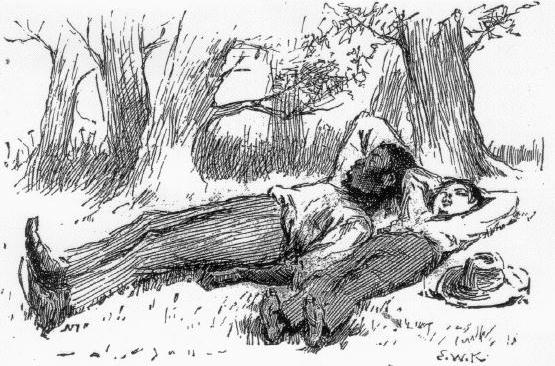
With regard to Huck Finn documenting the history of slavery, there are a couple of other interesting things hidden away in the novel, such as this picture by the official illustrator of the novel:

http://upload.wikimedia.org/wikipedia/commons/0/0e/Jim_and_ghost_huck_finn.jpg
Jim and Huck (E. W. Kemble)

What's interesting about this picture, as the people working on the Mark Twain Project have pointed out, is that it directly quotes another picture, which was used in the campaign to abolish slavery:

(c) New York Public Library

Apparently, in order to raise awareness about the evil of slavery, this image was printed onto pamphlets, stationary and even goods such as pottery. I don't know about you, but I have to admit I find stuff like that fascinating - and I'm glad there are people out there researching this, because I would've had no clue otherwise.

Superstition in Huckleberry Finn

What's also fascinating, historically speaking, are all the different superstitions that are infused into the novel: like the belief that you can cure a rattle-snake bite by drinking lots of whisky. This happens near the beginning of the book when poor Jim is bitten by one of these snakes (because of Huck's stupidity, frankly) and the first thing he does is grab a jug of whisky. He also asks Huck to cut off the dead snake's rattles and tie them around his wrists, since that is supposed to help too. There are loads of other superstitions in the novel too - about spiders and witches and hairballs, funnily enough. It's a lot of fun, really!

Regarding the thing about the snake, again with the help of the Mark Twain Project I found out that this was in all actuality the sort of advice you would get from doctors at the time:
Internally, give the patient all the Whisky he can drink. From a quart to a gallon should be drunk in six or eight hours. No fears need be entertained of making the patient drunk. You may fill him with Whisky, then let him swim in it, and it will not make him drunk, so long as the poison of the snake remains in the system. - Gunn's New Family Physician (1867).
... Let him swim in it? ... Alright ...

Selling Huckleberry Finn

There's this webpage called Mark Twain in his Times, which I absolutely adore, as it gives profound insight into the way Mark Twain lived, how he published his books, what his contemporaries thought about him, etc. One of the things it necessarily has a lot of interesting information about is the publication and promotion of Huckleberry Finn - I've picked out two interesting details for this post, but you can always go and browse around for yourself at this address.

1) Sales Prospectus Poster of 1884

1885 PROMOTIONAL POSTER
(c) Clifton Waller Barrett Collection

So this was one of the posters they would use to sell the new book - I find some of the phrasing truly hilarious fascinating:
"Not a sentence of this book has ever before appeared in print in any form."
I suppose they were sad that they couldn't claim the same thing about every word ...
"This book is simply irresistible, and is pronounced by an author OF WORLD-WIDE Reputation and HIGH AUTHORITY, who has read the manuscript: 'The brightest and most humorous book that Mark Twain has ever written.'"
That's lovely but ... who IS this author you speak of? Unless ... is this Hemingway speaking from the future? >___>

2) Defacing the sales prospectus

Apparently, they had a bit of a prankster working at the printers' where the sales prospectus came into being. It was never found out who did it, but it seems that one of the illustrations that were meant to accompany the prospectus was altered in a ... let's say indecent way. It concerns the illustration of Uncle Silas near the end of the book. You can look at it here, but be careful since it's not safe for work!

Jim and Huck's friendship - or "Why I love this book"

Jim and Huck (E. W. Kemble)

And now we finally get to the part in which this post turns into somewhat of a review, at last. If you've made it this far I applaud you.

So, the most interesting part of the book for me was the relationship between Jim and Huck. A) Because it's lovely how Jim treats him almost like a son and B) because Huck's emotional and moral development with regard to Jim is fascinating. I think we all know how hard it is to go against all the rules of the society you've been brought up in, even if your gut is telling you that those rules are wrong. And that's exactly why Huck's actions are so fascinating: even though he is torn between protecting Jim and telling on him numerous times, he always chooses the right course of action in the end, going by his gut feeling instead of what he has been taught all his life - and I admire him so much for that.

Equally though, I admire Jim for his wisdom and his kindness, and the way he manages to set Huck right when he does something stupid or mean. The most memorable moment (to me) in that regard happens after Huck has decided to play a rather cruel trick on Jim, who had believed his young friend to be dead. This is what Jim says:
“[...] When I got all wore out wid work, en wid de callin’ for you, en went to sleep, my heart wuz mos’ broke bekase you wuz los’, en I didn’ k’yer no’ mo’ what become er me en de raf’. En when I wake up en fine you back agin, all safe en soun’, de tears come, en I could a got down on my knees en kiss yo’ foot, I’s so thankful. En all you wuz thinkin’ ‘bout wuz how you could make a fool uv ole Jim wid a lie. Dat truck dah is trash; en trash is what people is dat puts dirt on de head er dey fren’s en makes ‘em ashamed.” 
Then he got up slow and walked to the wigwam, and went in there without saying anything but that. But that was enough. It made me feel so mean I could almost kissed his foot to get him to take it back. - Adventures of Huckleberry Finn, Ch. 15
I love this passage so much. I love how confident Jim is, and how honest and straightforward - and I love how much of an effect his words have on Huck. It really shows the budding depth of their friendship - I only wish there could've been more moments like this in the book than there actually were.

So, to sum it up, how much did I enjoy this book? I think I'd give it four rafts out of five - just because I really could not stand the episodes about the two conmen, and the ending of the book was a bit of a letdown (even if it does make perfect sense psychologically speaking, as is explained in detail here). I'm sure as hell going to pick this one up again!

Links & References

Ballard, AB 1982, 'What Huck Finn Says to a Black Child', The New York Times 9 May. Available from: http://www.nytimes.com/1982/05/09/opinion/l-what-huck-finn-says-to-a-black-child-123132.html. [10 March 2015].

Gunn, JC 1876 Gunn’s New Family Physician: or, Home Book of Health. 100th ed. Cincinnati, New York: Moore, Wilstach and Baldwin.

Mark Twain Project Online 2015. Available from: http://www.marktwainproject.org/.

Railton, S 2012, Mark Twain in His Times. Available from: http://twain.lib.virginia.edu/index2.html.

The Daily Show 2011, Mark Twain Controversy (video file) 11 January 2011, Available from: http://thedailyshow.cc.com/videos/9ez59y/mark-twain-controversy.

Twain, M 1885 Adventures of Huckleberry Finn. New York: Charles L Webster.

Sunday, 1 March 2015

Asterix: The Land of the Gods

Yesterday I went to see the new Asterix film with my brother. First off, my initial reaction:


(c) onlyknowyouloveherwhenyouletgo (tumblr)

This film was great, honestly! Much, much better than any of the recent Asterix films that have been produced - which especially includes all those live-action ones (I absolutely hated those). First of all, for anyone who would like to have a look at the trailer:


There were so many things that I liked about this film, I don't even know where to begin - so this will be a rather haphazard list, I'm afraid. Sorry!

First of all, they actually had the Romans say Latin phrases from time to time - just like they would in the comics! It's a small point, admittedly, but I really think it's great that they took so much care to try and adhere to the spirit of the comics!

(c) Goscinny & Uderzo: The Laurel Wreath

Second, this film is funny. Not every joke hits its mark, of course, particularly not for me since I'm not likely to laugh just because someone gets hit over the head. BUT there are so many plays on words and funny situations - it's charming really! And since humour is one of the most important features of Asterix, it's important to get this right.

Third, Asterix is so damn cute in this film. Seriously, just look at this picture for instance:

Asterix is not amused. 

And that's just the beginning really - there are so many shots in this film, which make him look even more endearing. And don't even get me started on Dogmatix. It's a wonder I got out of that cinema alive.

Fourth, the music is brilliant! The film's got a truly great score, and I really enjoyed the insertion of "Ti amo" by Sara Perchè at some point in the middle of the film, when Asterix felt like his world was going crazy. It really fit the mood of the moment - and, well, I like that song anyway ;)!

Fifth, the opening credits are a true work of art. In style, they are very similar to the opening credits of the recent Tintin film by Spielberg and Jackson:


In the opening credits of the Asterix film, obviously it's Asterix who's running into various, dangerous situations that sort of start blending into each other - not Tintin. Once again it's so well-made, I'd go to the cinema again just to see this sequence a second ... or third ... or even fourth time ;).

Lastly, and most importantly (to me), the film is really about something. It's not just slapstick humour and an arrangement of funny, little moments. There is a real conflict at the heart of the film, one that not only puts Romans against Gauls, but also opens up a rift between the villagers of our favourite Armorican settlement - and that's were things get really interesting. I won't tell you any more in case you still want to see the film, but honestly? It's glorious!

The only negative point that I've got to make is about Caesar. He just wasn't in character for me - and funnily enough, Asterix says something similar at the end of the film, when he accuses Caesar of not keeping to the rules of the game as he usually does. The problem is that he acts too much like a crazy dictator - complete with manic laughter, crazy plans and total disregard for his subordinates. The Caesar from the comic books just isn't like that - he's cold and calculating, yes, and he acutally doesn't care much about his underlings ... but he's not crazy. He's super intelligent and cruel - but not in the mad, shouting way he acts in the film.

Overall though, this does not detract much from the quality of the film, since all of the other characters are so well portrayed and the film in its entirety is just so lovely!

Rating: Where is the TARDIS?! I need to see this film again!

Friday, 2 January 2015

William Blake - The Tyger

So, for those of you who know me personally, it will come as no surprise when I tell you that I tend to hate poetry. (... Alright, maybe hate is a word that's too strong in this context, but I really dislike it.) This is because I find it obscure and the way you should read it just doesn't match up with the way I like to read: which is turning pages the fastest way possible and getting on with the story. With poetry, however, you're supposed to read the poem more than once in order to appreciate the sound of it and also to think a while about the way the words are arranged to discover their meaning. I have to admit, I'm just not patient enough for all that ...

However, as with every rule, there is one exception to it, which has actually made me reconsider my opinion of poetry a bit. I know, I know. I'm not quite over the shock myself ...

http://i.giflike.com/bGq2r5Q.gif

What is this poem of magic? It's William Blake's The Tyger. I really love it: I love the alliteration, the topic (a tiger - yay!), the metaphors, the descriptions, the rhymes ... it's lovely! But before I get more deeply into all that, here's the poem, first of all:
The Tyger
Tyger Tyger, burning bright
In the forests of the night;
What immortal hand or eye,
Could frame thy fearful symmetry?
And what shoulder, & what art,
Could twist the sinews of thy heart?
And when thy heart began to beat,
What dread hand? & what dread feet?

What the hammer? what the chain,
In what furnace was thy brain?
What the anvil? what dread grasp,
Dare its deadly terrors clasp!

When the stars threw down their spears
And water'd heaven with their tears:
Did he smile his work to see?
Did he who made the Lamb make thee?

Tyger Tyger burning bright,
In the forests of the night:
What immortal hand or eye,
Dare frame thy fearful symmetry?
I'll let you take a deep breath and calm down after all this excitement, before I move on ...

...

All set? Alright, so the first thing that I really love about it are the images that it creates in my mind when I read it: the orange fur of the tiger that "burns" in the dark forests of the night - it's like a warm torch burning in the darkness. And then there's the contrast between the innocence of the lamb and all this war-related vocabulary that is used in connection with the tiger: "the hammer", "the chain", "the spears", etc. I think it captures the fear that we all would feel when faced with a tiger perfectly - they are amazing predators after all.

If you're interested in finding out more about the poem (structure, symbols, meaning, etc.), I really recommend looking through the analysis that the good people of shmoop.com and sparknotes.com have put together. You can find those here and here. I'm just going to mention a few of the things that I found most interesting about it!

The repetition of the word "Tyger"

It sounds a bit like an enchantment, doesn't it? In terms of structure, it reminds me a bit of the famous witches' enchantment in Macbeth, since you've got repetition as well as alliteration there as well:
Double, double toil and trouble,
Fire burn and cauldron bubble
Of course, nowadays we all know those lines from the Harry Potter films, don't we? ;)


Anyway, to get back on topic: the reason why I find this to be relevant for the poem is that Blake seems to cast the tiger as a very mysterious animal in it. It doesn't even seem like much of an animal, but rather like something straight out of everybody's worst nightmare: you know, with the sinews of the heart, the brain that was made in a furnace, etc. So, to make the beginning of the poem sound like an enchantment just adds to the eerie atmosphere of it, I think. It's a genius move on Blake's part.

On the other hand, the repetition could also be a representation of the speaker thinking aloud. Like nowadays too, you know that whenever people are contemplating something aloud or they've lost something, they tend to repeat the thing they're thinking about to themselves, as in: "Keys, keys, where are my keys?" So, when the speaker is repeating the word to himslef, he's in effect saying: "Tiger, tiger - well, what the heck are you?"

What's up with the "fearful symmetry"? And why is it "framed"?

I think the symmetry that is meant here is probably the tiger's stripes. They're pretty symmetrical, aren't they? Let's have a look ...

Awww ...

Well, almost symmetrical at least ...

As for why this is the only word that breaks up the the rhyme scheme of this poem, I've come up with two explanations:

1) The modern pronunciation of the word is different from the one of William Blake's time, which means that it should really be symmetry as in "try", rather than symmetry as in "tree". Boring, but probably the more likely explanation.

2) It's no coincidence that there is a break in the rhyme scheme at the end of the first stanza. The speaker has discovered something that's out of sorts with his world, namely that there is something as dreadful as the tiger, and he experiences this as jarring: that's why he fails to come up with a rhyme. 

Personally, I like the second explanation better, even if it is the more unlikely one. Plus, I think it's funny that the the only word that goes against the poem's symmetry in terms of rhyme scheme is the word symmetry itself - talk about irony.

Regarding the word "framed", the people of shmoop have pointed out that the meaning is probably close to "to contain" - as in, "Who could have framed/contained the tiger with all its deadly attributes in this shape?". So what the speaker seems to be really asking is, "Who put the tiger in the tiger?" :P

The significance of "fire"

Fire plays a very important and prominent role in this poem: it's in the tiger's fur ("burning bright"), its eyes ("burnt the fire of thine eyes"), and even its brain ("in what furnace was thy brain"). This is interesting when one considers the symbolic meaning of fire, which on the one hand relates to power and destruction, but on the other hand also life and sacredness (particularly, if you think about the holy spirit, which came down on Jesus disciples at Pentecost in the shape of tongues of fire). 

In one word only, we've got the essence of the poem here, then, which is the wonder that the speaker expresses at God and his creation, being astounded by both its beauty and its frightfulness. But more on this in the next section.

The switch from "could" to "dare"

The most observant of you will probably have noticed this on your first read through the poem (I didn't till my third or fourth go), but the first and the last stanza are actually not exact copies of each other. There is a one word difference, and that's the switch from "What immortal hand or eye / could frame thy fearful symmetry" to "What immortal hand or eye / dare frame thy fearful symmetry". It seems that while in the beginning of the poem the speaker is questioning the ability as well as identity of someone to create something as fearful as the tiger, at the end he's more concerned with the morality of the decision: Who would even dare to create a killing machine such as the tiger? (We'll leave the issue that that's not really a fair or very real representation of the tiger aside for the moment ...)

It really drives the whole point about the speaker's doubts about a benevolent God in the face of all the inherent cruelty in creation home. After all, if you believe in God, the question of who put all the creatures on earth is not really a difficult one. The part where it gets thorny is the why question. Why are we here? And why is there so much suffering in the world, when God is supposed to love us?

*coughs*

Alright, I'm done philosophising, you can all wake up again ...

http://i.giflike.com/xbK67Ea.gif

Let's move on to more fun stuff!

Goodies

Unsurprisingly, I'm not the only one who really likes this poem, and there's tons of good stuff in relation to The Tyger on the web. Here's a little selection of the stuff that I have found:

Readings

There are a number of good readings of the poem on youtube, but this is the best one in my opinion. It's rather eerie to listen to, which fits the atmosphere of the poem perfectly. I really got goose-bumps on my arms when I listened to it the first time!


There is another "reading" of sorts, which I really like - only it's not a reading, really, but rather a singing! Somebody on youtube has been kind enough to compose some music to accompany the text of this poem and turn the whole thing into a song:


I like this, because I think it catches the rhythm of the poem really well!

Illustrations

Another thing that you can find on the internet are the coloured illustrations (drawn by William Blake himself, I believe) that accompany the original manuscript. I'll show you two of the ones I like best, but, if you feel like it. you can have a look at more of them at the William Blake Archive.

https://blogger.googleusercontent.com/img/b/R29vZ2xl/AVvXsEgRGTJdwTgbT77pSSqbQqMc_hdSQeKyvqHg-qyeHv6_SunrTYGMRvCVjMtWuRqokPOusdeou4JuoCe4x0BJfG_w5IPrgZ-0OGw5FbUVbd-j5ShlhDHgGBepPQRwaiQfsdsyafRbmxj-zLJ4/s1600/British+Museum+(I%2Bthink).jpghttps://blogger.googleusercontent.com/img/b/R29vZ2xl/AVvXsEjIKS3MNfmHi8k8FOBgSpa3pOpQTwny3Opm61GEM3qMKPxqCEZ7p1rjuGMlrmeGKXpd9Y4PDM9A79R5zTSnS2STJFJq1gPYORLL-eFt3ebf4Ekmi_HY3idl22hoPV_vkrAaU3ygG1I_4F0j/s1600/Fitzwilliam+museum.jpg

The first of these two is taken from the copy T of the British Musuem, while the second one can be found in the copy AA owned by the Fitzwilliam Museum in Cambridge, England. 

Mamma mia, this post is getting long again - I think I'll let it go at this point! I suppose this is what happens when I love something excessively. Thank God I didn't keep a blog when I was reading Harry Potter ...

References, Sources, Links & the Like


The Tyger (analysis - shmoop): http://www.shmoop.com/tyger/

The Tyger (analysis - sparknotes): http://www.sparknotes.com/poetry/blake/section6.rhtml


YouTube videos:

Harry Potter: https://www.youtube.com/watch?v=Z2xfpoQx6oI
Reading: https://www.youtube.com/watch?v=QMwNvzRKX64
Song: https://www.youtube.com/watch?v=cFexFkJwrAo

Saturday, 27 December 2014

Hergé - Coke en Stock (Les Aventures de Tintin #19)


Tout d’abord, je vous prie d’excuser mon français – je l’apprenais à l’école il y a six ans et depuis ce temps-là, il ne s’est pas amélioré. Pardon à tous!
 
Alors, pour commencer avec cette critique : j’adore la série de « Tintin ». Je l’adorais depuis mon enfance, parce qu’il y a des aventures, un protagoniste très aimable, un chien super mignon, et beaucoup de pays inconnus. Ce que j’adorais le plus, cependant, c’est l’amitié du capitaine Haddock et Tintin. Dans cet album, ils sont meilleurs amis pour plusieurs ans déjà, et c’est évident par le haut degré de confiance Tintin met au capitaine et vice versa. De plus, ils se complètent parfaitement quant à leurs personnalités : Tintin est un jeune homme très poli, curieux, prudent et vertueux, tandis que le capitaine est un personne très drôle (sans le faire exprès), pas du tout poli, fidèle et connaissant le monde (surtout la mer) comme personne d’autre. Ensemble, ils constituent une équipe très aimable que personne ne peut arrêter. 

Dans cette bande il y a beaucoup de scènes qui montrent précisément cela, surtout à la fin, quand Tintin et Haddock doivent se battre avec leurs ennemis : alors que Haddock conduit le navire, Tintin appelle à l’aide avec la radio et c’est comme ça que les deux peuvent être sauvés par les Américains avant d’être immergé dans la mer. D’ailleurs, il y a beaucoup de scènes très mignonnes : par exemple, quand un avion explose et Haddock s’inquiète pour Tintin. C’est vraiment très mignon – et drôle à la fois, parce qu’au moment d’explosion, capitaine Haddock tient une bouteille d'alcool à la main. Quand il entend l’explosion il s’inquiète pour sa bouteille d’abord, et se réjouit qu’elle est saine et sauve. Mais peu après il se rappelle que Tintin voulait voir cet avion, et à cause de sa panique soudaine, il casse sa bouteille lui-même. Naturellement ça lui rend un peu fâché, mais il s’inquiète davantage du sort de Tintin.

Haddock s'inquiète pour Tintin. (p.19-20)

Même si l’amitié de Tintin et Haddock dans cette bande dessinée est vraiment mignonne et il y a beaucoup de situations drôles, il y a à la fois un aspect qui est problématique : la représentation des Soudanais et Sénégalais. Certainement, avec l’esclavage moderne, Hergé choisissait un sujet assez pertinent pour cette BD. Au 21ère siècle aussi, malheureusement, elle existe encore : selon la BBC presque 30 millions gens en 162 pays doivent vivre comme esclaves (http://www.bbc.com/news/world-24573127). L’indignation de Capitaine Haddock quand il découvre que cette abomination existe encore est très compréhensible – et sa réaction de maudire les négrier avec toutes les malédictions qu’il connaît est vraiment juste. 


Haddock maudit le négrier. (p. 49)

Tout de même, la description des Soudanais et Sénégalais comme des gens bonnes mais à la fois simples (tout à fait comme enfants) est problématique, c’est le moins qu’on puisse dire. Quand le Capitaine Haddock leurs expliquent qu’ils seraient vendus comme esclaves s’ils continuaient leur voyage à la Mecque, ils ne le croient pas et répètent plusieurs fois qu’ils sont simplement « de bons Musulmans » (p. 47) en pèlerinage au tombeau du Prophète. Aïe, n’est-ce pas ? Je trouve la description des Africains comme des hommes crédules, extrêmement religieux et n’étant pas conscient de leur propre sort proche de racisme. En tout cas, ça me fait grimace.

Extrait de la page 47:


D’ailleurs, leur façon de parler semble un peu simple à moi : ils tendent à commencer leurs phrases avec le même mot et la structure de leurs phrases n’a pas beaucoup de variations. Pour la plupart, l’ordre est substantif – verbe – adjectif/complément de lieu/complément de temps, etc. Par exemple : « Oui, cap’taine, bien compris. Il est très méchant, cet Arabe. On veut pas être esclaves, nous. On veut simplement aller à la Mecque. » (p. 50) Certainement, il est très difficile de nier que c’est raciste.

En même temps, la chose que je trouve intéressant est qu’il y a deux personnes d’autre qui ne maîtrise pas un français parfait : Szut, l’homme d’Estonie, et le général Alcazar, venant de l’Amérique du Sud. Tandis que le dernier se distingue surtout par son accent espagnol (« yé … oui, yé voyage … Mais … excousez-moi, yé souis très pressé … Déyà en rétard à ouné rendez-vous … Yé vous quitte. » (p. 2)), la façon de parler du premier est vraiment simple. Pour la plupart, il peut seulement parler en phrases incomplètes et erronées : « Alors eux fâchés … Cassé le radio et battre avec moi … Alors moi … knock-out … Eux partis ?... » (p. 46)

Malgré cette circonstance, la façon de parler des Soudanais et Sénégalais me rend mal à l’aise – peut-être c’est à cause de la combinaison simple langue en plus d’une personnalité simple. En tout cas, je le trouve très problématique et je pense qu’il est important d’être sensible en ce qui concerne la représentation des autres nationalités.

En résumé, l’histoire de cette bande de Tintin présente une aventure passionnante, en figurant beaucoup de scènes mignonnes et drôles avec Tintin et capitaine Haddock (qui sont le cœur d’histoire, à mon avis). Toutefois, la BD également ouvre une fenêtre à un temps en Europe quand la représentation des autres nationalités dans la culture pop était problématique jusqu’au point d’être raciste et il est important d’être conscient de cela lors de la lecture.

Bibliographie

HERGÉ. (1958) Les Aventures de Tintin: Coke en Stock. Paris: Casterman.

Couverture du livre

http://en.wikipedia.org/wiki/The_Red_Sea_Sharks#mediaviewer/File:The_Adventures_of_Tintin_-_19_-_The_Red_Sea_Sharks.jpg