Saturday, 14 March 2015

Mark Twain - Huckleberry Finn

Cover of the 1st edition

So, I finished reading Huckleberry Finn almost a week ago now, and if I'm totally honest, I still have no clue what I think about it exactly. To be clear: there are a lot of bits which I really loved, and I'm going to show some of them to you later on. Equally though, there was quite a bit of stuff that I did not enjoy at all - first and foremost the glaring use of the n-word throughout the book. So let's get right to that to have it out of the way.

Racism in Huckleberry Finn

So, I get that this book was written at a very specific point in time and that Mark Twain probably chose to include the n-word for authenticity reasons, among others ... but that didn't and doesn't make it any easier for me to read it. And that's on the one hand because I only recently saw Selma, and on the other because of reports by students such as this one:
I can still recall the anger I felt as my white classmates read aloud the word "nigger". In fact, as I write this letter I am getting angry all over again. I wanted to sink into my seat. Some of the whites snickered, others giggled. I can recall nothing of the literary merits of this work that you term "the greatest of all American novels". I only recall the sense of relief I felt when I would flip ahead a few pages and see the word "nigger" would not be read that hour. - Allen B. Ballard (Letter to the Editor, NYT, 1982)
It's just such a painful, nasty term - and encountering it in this novel which is supposed to be one of the greats obviously hurts and makes me feel uncomfortable.

So, I really had no clue how to deal with this until I found this segment of The Daily Show in which Larry Wilmore makes some truly excellent points about the use of the n-word and why it needs to stay in the book, despite attempts to have it removed:


For me, the most important point that Larry Wilmore makes (and it's almost drowned out) is this: the word is supposed to make you feel uncomfortable. I think all evidence points to the fact that Mark Twain chose to use the n-word for a reason, which was to contrast the savagery of the white people who would use it with the loyalty, intelligence and good-heartedness of Jim and other black people. This comes through most clearly in the drunken tirade of Huck's father, in which he truly reveals himself to be the mean-spirited, evil person that he is:
There was a free nigger there from Ohio - a mulatter, most as white as a white man. He had the whitest shirt on you ever see, too .... They said he was a p'fessor in a college, and could talk all kinds of languages, and knowed everything. And that ain't the wust. They said he could VOTE when he was at home. Well, that let me out. Thinks I, what is the country a-coming to? It was 'lection day, and I was just about to go and vote myself if I warn't too drunk to there; but when they told me there was a State in this country where they'd let that nigger vote, I drawed out. I says I'll never vote agin .... And to see the cool way of that nigger - why, he wouldn't a give me the road if I hadn't shoved him out o' the way. I says to the people, why ain't this nigger put up at auction and sold? - that's what I want to know. And what do you reckon they said? Why, they said he couldn't be sold till he'd been in the State six months. - Adventures of Huckleberry Finn, Ch. 6
It's ironic, isn't it? A drunk failure of a man who has no pleasure in life except to make his own son's existence miserable has the audacity to slur against another, obviously well-educated man, just because of his skin colour. It's the epitome of superficiality and only emphasises the stupidity of Huck's father.

So, even though I still feel hugely uncomfortable reading this word, I've now sort of come to terms with why it's important that it stays in the book. I suppose, in the end, it's like a mirror to the past: it shows us what we once were and what we must never return to. And with that in mind it would be wrong to cleanse the book of it and thereby change history just because it offends our sensibilities now.

With regard to Huck Finn documenting the history of slavery, there are a couple of other interesting things hidden away in the novel, such as this picture by the official illustrator of the novel:

http://upload.wikimedia.org/wikipedia/commons/0/0e/Jim_and_ghost_huck_finn.jpg
Jim and Huck (E. W. Kemble)

What's interesting about this picture, as the people working on the Mark Twain Project have pointed out, is that it directly quotes another picture, which was used in the campaign to abolish slavery:

(c) New York Public Library

Apparently, in order to raise awareness about the evil of slavery, this image was printed onto pamphlets, stationary and even goods such as pottery. I don't know about you, but I have to admit I find stuff like that fascinating - and I'm glad there are people out there researching this, because I would've had no clue otherwise.

Superstition in Huckleberry Finn

What's also fascinating, historically speaking, are all the different superstitions that are infused into the novel: like the belief that you can cure a rattle-snake bite by drinking lots of whisky. This happens near the beginning of the book when poor Jim is bitten by one of these snakes (because of Huck's stupidity, frankly) and the first thing he does is grab a jug of whisky. He also asks Huck to cut off the dead snake's rattles and tie them around his wrists, since that is supposed to help too. There are loads of other superstitions in the novel too - about spiders and witches and hairballs, funnily enough. It's a lot of fun, really!

Regarding the thing about the snake, again with the help of the Mark Twain Project I found out that this was in all actuality the sort of advice you would get from doctors at the time:
Internally, give the patient all the Whisky he can drink. From a quart to a gallon should be drunk in six or eight hours. No fears need be entertained of making the patient drunk. You may fill him with Whisky, then let him swim in it, and it will not make him drunk, so long as the poison of the snake remains in the system. - Gunn's New Family Physician (1867).
... Let him swim in it? ... Alright ...

Selling Huckleberry Finn

There's this webpage called Mark Twain in his Times, which I absolutely adore, as it gives profound insight into the way Mark Twain lived, how he published his books, what his contemporaries thought about him, etc. One of the things it necessarily has a lot of interesting information about is the publication and promotion of Huckleberry Finn - I've picked out two interesting details for this post, but you can always go and browse around for yourself at this address.

1) Sales Prospectus Poster of 1884

1885 PROMOTIONAL POSTER
(c) Clifton Waller Barrett Collection

So this was one of the posters they would use to sell the new book - I find some of the phrasing truly hilarious fascinating:
"Not a sentence of this book has ever before appeared in print in any form."
I suppose they were sad that they couldn't claim the same thing about every word ...
"This book is simply irresistible, and is pronounced by an author OF WORLD-WIDE Reputation and HIGH AUTHORITY, who has read the manuscript: 'The brightest and most humorous book that Mark Twain has ever written.'"
That's lovely but ... who IS this author you speak of? Unless ... is this Hemingway speaking from the future? >___>

2) Defacing the sales prospectus

Apparently, they had a bit of a prankster working at the printers' where the sales prospectus came into being. It was never found out who did it, but it seems that one of the illustrations that were meant to accompany the prospectus was altered in a ... let's say indecent way. It concerns the illustration of Uncle Silas near the end of the book. You can look at it here, but be careful since it's not safe for work!

Jim and Huck's friendship - or "Why I love this book"
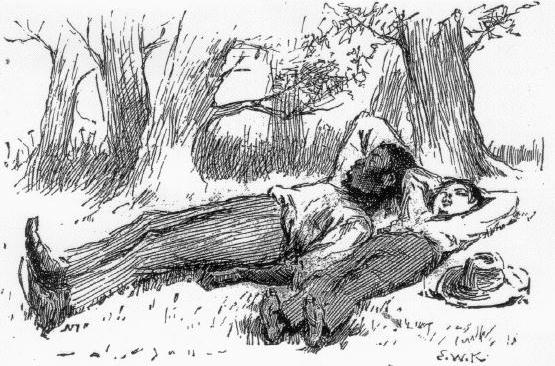
Jim and Huck (E. W. Kemble)

And now we finally get to the part in which this post turns into somewhat of a review, at last. If you've made it this far I applaud you.

So, the most interesting part of the book for me was the relationship between Jim and Huck. A) Because it's lovely how Jim treats him almost like a son and B) because Huck's emotional and moral development with regard to Jim is fascinating. I think we all know how hard it is to go against all the rules of the society you've been brought up in, even if your gut is telling you that those rules are wrong. And that's exactly why Huck's actions are so fascinating: even though he is torn between protecting Jim and telling on him numerous times, he always chooses the right course of action in the end, going by his gut feeling instead of what he has been taught all his life - and I admire him so much for that.

Equally though, I admire Jim for his wisdom and his kindness, and the way he manages to set Huck right when he does something stupid or mean. The most memorable moment (to me) in that regard happens after Huck has decided to play a rather cruel trick on Jim, who had believed his young friend to be dead. This is what Jim says:
“[...] When I got all wore out wid work, en wid de callin’ for you, en went to sleep, my heart wuz mos’ broke bekase you wuz los’, en I didn’ k’yer no’ mo’ what become er me en de raf’. En when I wake up en fine you back agin, all safe en soun’, de tears come, en I could a got down on my knees en kiss yo’ foot, I’s so thankful. En all you wuz thinkin’ ‘bout wuz how you could make a fool uv ole Jim wid a lie. Dat truck dah is trash; en trash is what people is dat puts dirt on de head er dey fren’s en makes ‘em ashamed.” 
Then he got up slow and walked to the wigwam, and went in there without saying anything but that. But that was enough. It made me feel so mean I could almost kissed his foot to get him to take it back. - Adventures of Huckleberry Finn, Ch. 15
I love this passage so much. I love how confident Jim is, and how honest and straightforward - and I love how much of an effect his words have on Huck. It really shows the budding depth of their friendship - I only wish there could've been more moments like this in the book than there actually were.

So, to sum it up, how much did I enjoy this book? I think I'd give it four rafts out of five - just because I really could not stand the episodes about the two conmen, and the ending of the book was a bit of a letdown (even if it does make perfect sense psychologically speaking, as is explained in detail here). I'm sure as hell going to pick this one up again!

Links & References

Ballard, AB 1982, 'What Huck Finn Says to a Black Child', The New York Times 9 May. Available from: http://www.nytimes.com/1982/05/09/opinion/l-what-huck-finn-says-to-a-black-child-123132.html. [10 March 2015].

Gunn, JC 1876 Gunn’s New Family Physician: or, Home Book of Health. 100th ed. Cincinnati, New York: Moore, Wilstach and Baldwin.

Mark Twain Project Online 2015. Available from: http://www.marktwainproject.org/.

Railton, S 2012, Mark Twain in His Times. Available from: http://twain.lib.virginia.edu/index2.html.

The Daily Show 2011, Mark Twain Controversy (video file) 11 January 2011, Available from: http://thedailyshow.cc.com/videos/9ez59y/mark-twain-controversy.

Twain, M 1885 Adventures of Huckleberry Finn. New York: Charles L Webster.

Sunday, 1 March 2015

Asterix: The Land of the Gods

Yesterday I went to see the new Asterix film with my brother. First off, my initial reaction:


(c) onlyknowyouloveherwhenyouletgo (tumblr)

This film was great, honestly! Much, much better than any of the recent Asterix films that have been produced - which especially includes all those live-action ones (I absolutely hated those). First of all, for anyone who would like to have a look at the trailer:


There were so many things that I liked about this film, I don't even know where to begin - so this will be a rather haphazard list, I'm afraid. Sorry!

First of all, they actually had the Romans say Latin phrases from time to time - just like they would in the comics! It's a small point, admittedly, but I really think it's great that they took so much care to try and adhere to the spirit of the comics!

(c) Goscinny & Uderzo: The Laurel Wreath

Second, this film is funny. Not every joke hits its mark, of course, particularly not for me since I'm not likely to laugh just because someone gets hit over the head. BUT there are so many plays on words and funny situations - it's charming really! And since humour is one of the most important features of Asterix, it's important to get this right.

Third, Asterix is so damn cute in this film. Seriously, just look at this picture for instance:

Asterix is not amused. 

And that's just the beginning really - there are so many shots in this film, which make him look even more endearing. And don't even get me started on Dogmatix. It's a wonder I got out of that cinema alive.

Fourth, the music is brilliant! The film's got a truly great score, and I really enjoyed the insertion of "Ti amo" by Sara Perchè at some point in the middle of the film, when Asterix felt like his world was going crazy. It really fit the mood of the moment - and, well, I like that song anyway ;)!

Fifth, the opening credits are a true work of art. In style, they are very similar to the opening credits of the recent Tintin film by Spielberg and Jackson:


In the opening credits of the Asterix film, obviously it's Asterix who's running into various, dangerous situations that sort of start blending into each other - not Tintin. Once again it's so well-made, I'd go to the cinema again just to see this sequence a second ... or third ... or even fourth time ;).

Lastly, and most importantly (to me), the film is really about something. It's not just slapstick humour and an arrangement of funny, little moments. There is a real conflict at the heart of the film, one that not only puts Romans against Gauls, but also opens up a rift between the villagers of our favourite Armorican settlement - and that's were things get really interesting. I won't tell you any more in case you still want to see the film, but honestly? It's glorious!

The only negative point that I've got to make is about Caesar. He just wasn't in character for me - and funnily enough, Asterix says something similar at the end of the film, when he accuses Caesar of not keeping to the rules of the game as he usually does. The problem is that he acts too much like a crazy dictator - complete with manic laughter, crazy plans and total disregard for his subordinates. The Caesar from the comic books just isn't like that - he's cold and calculating, yes, and he acutally doesn't care much about his underlings ... but he's not crazy. He's super intelligent and cruel - but not in the mad, shouting way he acts in the film.

Overall though, this does not detract much from the quality of the film, since all of the other characters are so well portrayed and the film in its entirety is just so lovely!

Rating: Where is the TARDIS?! I need to see this film again!

Wednesday, 25 February 2015

Interesting Facts about Mark Twain

After I started reading Huckleberry Finn last week, I began doing some research on the author, Mark Twain (I do that a lot ... I'm pretty much a research nerd). He was actually a really fascinating guy: he changed jobs a lot, travelled the world, and took a real interest in science - on top of being an excellent writer, of course. But that's just the tip of the iceberg! Here is some of the other stuff that I found out about him (all according to the internet, which as we all know is prone to misinformation - so beware ;)!):

So, what's in a name?

Quite a lot, apparently: his real name was actually Samuel Langhorne Clemens - Mark Twain was the pen name he gave himself which he came up with through the years he spent working on riverboats travelling up and down the Mississippi. "By the mark twain!" would be the call that the leadsmen on these boats would make when they measured the depth of the river and found it to be 2 fathoms deep or more - 2 fathoms being the minimum safe distance to the bottom in order for ships to pass through without sustaining damage. This was a process called "depth sounding", which nowadays is of course done by machines, rather than by using ropes.

Depth sounding in the 19th century (c) Wikimedia

Why "twain" though? Because it's a very old word for "two". Hence, "mark twain" really means "mark two" on the rope, which translates to 2 fathoms (= 12 ft or 3.7 m). And that's how mark twain became Mark Twain ;)!

His Birth and Death

Halley's comet (c) NASA
 
Both Mark Twain's birth and his death happened shortly after a comet known as Halley's Comet appeared in the sky over Earth. Apparently, this comet flies past our planet every 75 to 76 years, and Mark Twain felt a very special connection to it. He said the following in 1909, just one year before his death:
I came in with Halley's Comet in 1835. It is coming again next year, and I expect to go out with it. It will be the greatest disappointment of my life if I don't go out with Halley's Comet. The Almighty has said, no doubt: 'Now here are these two unaccountable freaks; they came in together, they must go out together.'
And then he really did die one day after the comet returned ... creepy, isn't it?

To give you the exact dates though:

Appearance of Halley’s Comet
Birth of Mark Twain
16/11/1830
30/11/1830
Appearance of Halley’s Comet
Death of Mark Twain
20/04/1910
21/04/1910

Bestselling Author

Since the first volume of his autobiography was only published in 2010 and became an immediate bestseller, he is one of the few authors who have managed to bring out bestsellers in three centuries. That's right. Three centuries. Damn impressive!

Lost in Translation

Of course, Mark Twain's works have been translated into many, many languages - but did you know that his first successful story was actually translated into classic Greek? An Oxford professor by the name of Sidgwick decided that it would make good practice for students learning to translate English into classic Greek, so he took the tale, changed the original setting to ancient Greece and translated it so that he could include it in his new textbook.

The frog that travelled the world (c) Susan Jaffe Tane

The funny thing is that when Twain discovered the translation of his own work, he was not aware that this was his own tale and thought that he had unwittingly adapted a classic Greek tale. He eventually discovered the truth though, when he visited this professor in England at a later date and was much disappointed.

And speaking of translations: when Mark Twain discovered the French translation of the same story, he decided to do a back-translation into English of it, giving it the title: "The Jumping Frog: In English, Then in French, and Then Clawed Back Into A Civilized Language Once More by Patient, Unremunerated Toil". I think his goal was to poke a bit of fun at the art of translation - which is a difficult job of course, and always destined to fail to some degree, since a translation will never be a 100% the same as the original. That's what he wanted to point out, in my opinion, which become clear in the introduction to the back-translation:
Even a criminal is entitled to fair play; and certainly when a man who has done no harm has been unjustly treated, he is privileged to do his best to right himself. My attention has just been called to an article some three years old in a French Magazine entitled, ‘Revue des Deux Mondes’ (Review of Some Two Worlds), wherein the writer treats of “Les Humoristes Americaines” (These Humorist Americans). I am one of these humorists American dissected by him, and hence the complaint I am making.
This gentleman’s article is an able one (as articles go, in the French, where they always tangle up everything to that degree that when you start into a sentence you never know whether you are going to come out alive or not). It is a very good article and the writer says all manner of kind and complimentary things about me—for which I am sure thank him with all my heart; but then why should he go and spoil all his praise by one unlucky experiment? What I refer to is this: he says my jumping Frog is a funny story, but still he can’t see why it should ever really convulse any one with laughter—and straightway proceeds to translate it into French in order to prove to his nation that there is nothing so very extravagantly funny about it. Just there is where my complaint originates. He has not translated it at all; he has simply mixed it all up; it is no more like the jumping Frog when he gets through with it than I am like a meridian of longitude. 
And here's an excerpt of the back-translation:

Original: There was a feller here once by the name of Jim Smiley, in the winter of ’49 or maybe it was the spring of ’50 I don’t recollect exactly, somehow, though what makes me think it was one or the other is because I remember the big flume warn’t finished when he first came to the camp; but anyway, he was the curiosest man about always betting on any thing that turned up you ever see, if he could get any body to bet on the other side; and if he couldn’t, he’d change sides.

Back-Translation: It there was one time here an individual known under the name of Jim Smiley; it was in the winter ’49, possibly well at the spring of ’50, I no me recollect not exactly. This which me makes to believe that it was the one or the other, it is that I shall remember that the grand flume is not achieved when he arrives at the camp for the first time, but of all sides he was the man the most fond of to bet which one have seen, betting upon all that which is presented, when he could find an adversary; and when he not of it could not, he passed to the side opposed.

He liked to be funny ;)!

(I'll be honest with you though, I don't quite understand what all the fuss is about - I read the story and didn't like it much at all - the ending was okay, but it just took forever to build up. Maybe I'm missing something though. You can read it yourself here, if you like: http://twain.lib.virginia.edu/projects/price/frog.htm It's very short, only about 4 A4 pages.)

Filmed by Edison

So, A) he was friends with Thomas Edison, which is cool in itself, and B) OMG THERE IS VIDEO FOOTAGE OF MARK TWAIN! Seriously, Thomas Edison came to Mark Twain's house in 1909 and filmed him for a few minutes. The clip is nothing extraoridnary in itself, of course - except for the fact that it's got Mark Twain in it ;)! You can watch it here (via YT):


The Terrors of the German Language

Oh, German - it seems that Mark Twain could not resist pulling you to pieces for your difficult grammar either. In 1897 he actually gave a speech in front of the Viennese print media club about the horrors of German syntax - the funny thing though? He did it in German!

For those of you who speak German, here's the original version: http://gutenberg.spiegel.de/buch/die-schrecken-der-deutschen-sprache-und-andere-kurze-texte-6678/1

And here's a translated version for those of you who don't (be careful though - it's a very literal version, which tries to stick close to the original): http://www.gutenberg.org/files/3188/3188-h/3188-h.htm#link2H_4_0008

His Grave

Now, this is something lovely that his daughter did for him, after he had died: she erected a monument above his grave which was exactly two fathoms high (= mark twain).

Monument above Mark Twain's grave (c) Wikimedia

Funny and Meaningful Quotes

Lastly, as a writer and a humorist he obviously said and wrote many meaninguful and funny things. Here's a selection of my favourite quotes (I double checked that it really was Mark Twain who said these things by looking at numerous websites and sources - so these should be alright!):

"Whenever you find yourself on the side of the majority, it is time to pause and reflect."

"There are many humorous things in this world, among them the white man's notion that he is less savage than the other savages."

"Lincoln's Proclamation [...] not only set the black slaves free, but set the white man free also."


"Only one thing is impossible for God: To find any sense in any copyright law on the planet."


"Reader, suppose you were an idiot. And suppose you were a member of Congress. But I repeat myself."

"Get your facts first, and then you can distort them as much as you please."

Links & References

Wikipedia on Mark Twain: http://en.wikipedia.org/wiki/Mark_Twain

Mark Twain House on Mark Twain: http://www.marktwainhouse.org/man/biography_main.php

Depth sounding: http://en.wikipedia.org/wiki/Depth_sounding & http://bymarktwain.com/

Back Translation of First Story: http://translation-blog.trustedtranslations.com/mark-twains-back-translation-2008-10-27.html & http://genius.com/Mark-twain-back-translation-the-celebrated-jumping-frog-of-calaveras-county-annotated#note-3834512

Sunday, 22 February 2015

Mark Twain - Huckleberry Finn

So, I started reading "The Adventures of Huckleberry Finn" recently. I read "The Adventures of Tom Sawyer" last year and promised myself I would read Huck Finn's story as soon as possible - which is apparently 10 months later. Ergo, I'm sloooow.

Like with "Tom Sawyer" I like the book fine enough for now - but it hasn't really caught my interest yet. There are some exciting bits - the part where (SPOILER: Huck fakes his own death) is just thrilling - and I enjoy Mark Twain's way of telling a stoy. You see, especially in the exciting parts, he stops telling you what the characters are doing and explaining their thought processes behind it, and instead just shows you. So, for instance in the scene where (SPOILER: Huck fakes his own death), Mark Twain doesn't explicitly tell you that that's what Huck is doing, but rather he just shows you all the little preparations he makes, and all the fake clues he plants. It's genius, because that way you're challenged as a reader to pay attention.

But anyway, I'm only on chapter 12, so I can't really do a review on this novel yet. So instead, in order to do a little update to this poor, neglected blog I thought I'd do a book cover compilation post - which for convenience purposes will include CD covers and other media too. Why? Because A) covers are pretty and B) they can also be hilarious. I'll show you ;). But to start with the pretty:

Book Covers I Would Paper My Walls With

First Edition

Mainly because it's the cover of the first edition, I believe ;). But it is still rather pretty - I like the way they played around with the font especially.

Penguin Classics Deluxe Edition

So, admittedly, Huck looks like he's about to enter into a smoking contest with Gandalf here, but I really like the colour scheme in this cover. It's very soft and calming, and I just enjoy looking at it.

Bantam Classics Edition

Another one in which I really like the color scheme. I think I'm just a fan of orange xD.

And now for the hilarious ...

Penguin Classics Edition

So, let me start this category off with being immature: when I skim over this image, I always, ALWAYS think that Huck is grabbing Jim's butt. (That hand is waaaay too close to the other guy's behind, I'm sorry ...)

Classic Comics Edition

In which Huck learns to spit lightning at his enemies ...

Classics Illustrated Edition

I can't shake the feeling that there's something wrong with Huck's teeth here. They're a bit ... horse-y?

Europa Edition (audiobook)

... They weren't really trying were they?

Hope you enjoyed those!

Friday, 2 January 2015

William Blake - The Tyger

So, for those of you who know me personally, it will come as no surprise when I tell you that I tend to hate poetry. (... Alright, maybe hate is a word that's too strong in this context, but I really dislike it.) This is because I find it obscure and the way you should read it just doesn't match up with the way I like to read: which is turning pages the fastest way possible and getting on with the story. With poetry, however, you're supposed to read the poem more than once in order to appreciate the sound of it and also to think a while about the way the words are arranged to discover their meaning. I have to admit, I'm just not patient enough for all that ...

However, as with every rule, there is one exception to it, which has actually made me reconsider my opinion of poetry a bit. I know, I know. I'm not quite over the shock myself ...

http://i.giflike.com/bGq2r5Q.gif

What is this poem of magic? It's William Blake's The Tyger. I really love it: I love the alliteration, the topic (a tiger - yay!), the metaphors, the descriptions, the rhymes ... it's lovely! But before I get more deeply into all that, here's the poem, first of all:
The Tyger
Tyger Tyger, burning bright
In the forests of the night;
What immortal hand or eye,
Could frame thy fearful symmetry?
And what shoulder, & what art,
Could twist the sinews of thy heart?
And when thy heart began to beat,
What dread hand? & what dread feet?

What the hammer? what the chain,
In what furnace was thy brain?
What the anvil? what dread grasp,
Dare its deadly terrors clasp!

When the stars threw down their spears
And water'd heaven with their tears:
Did he smile his work to see?
Did he who made the Lamb make thee?

Tyger Tyger burning bright,
In the forests of the night:
What immortal hand or eye,
Dare frame thy fearful symmetry?
I'll let you take a deep breath and calm down after all this excitement, before I move on ...

...

All set? Alright, so the first thing that I really love about it are the images that it creates in my mind when I read it: the orange fur of the tiger that "burns" in the dark forests of the night - it's like a warm torch burning in the darkness. And then there's the contrast between the innocence of the lamb and all this war-related vocabulary that is used in connection with the tiger: "the hammer", "the chain", "the spears", etc. I think it captures the fear that we all would feel when faced with a tiger perfectly - they are amazing predators after all.

If you're interested in finding out more about the poem (structure, symbols, meaning, etc.), I really recommend looking through the analysis that the good people of shmoop.com and sparknotes.com have put together. You can find those here and here. I'm just going to mention a few of the things that I found most interesting about it!

The repetition of the word "Tyger"

It sounds a bit like an enchantment, doesn't it? In terms of structure, it reminds me a bit of the famous witches' enchantment in Macbeth, since you've got repetition as well as alliteration there as well:
Double, double toil and trouble,
Fire burn and cauldron bubble
Of course, nowadays we all know those lines from the Harry Potter films, don't we? ;)


Anyway, to get back on topic: the reason why I find this to be relevant for the poem is that Blake seems to cast the tiger as a very mysterious animal in it. It doesn't even seem like much of an animal, but rather like something straight out of everybody's worst nightmare: you know, with the sinews of the heart, the brain that was made in a furnace, etc. So, to make the beginning of the poem sound like an enchantment just adds to the eerie atmosphere of it, I think. It's a genius move on Blake's part.

On the other hand, the repetition could also be a representation of the speaker thinking aloud. Like nowadays too, you know that whenever people are contemplating something aloud or they've lost something, they tend to repeat the thing they're thinking about to themselves, as in: "Keys, keys, where are my keys?" So, when the speaker is repeating the word to himslef, he's in effect saying: "Tiger, tiger - well, what the heck are you?"

What's up with the "fearful symmetry"? And why is it "framed"?

I think the symmetry that is meant here is probably the tiger's stripes. They're pretty symmetrical, aren't they? Let's have a look ...

Awww ...

Well, almost symmetrical at least ...

As for why this is the only word that breaks up the the rhyme scheme of this poem, I've come up with two explanations:

1) The modern pronunciation of the word is different from the one of William Blake's time, which means that it should really be symmetry as in "try", rather than symmetry as in "tree". Boring, but probably the more likely explanation.

2) It's no coincidence that there is a break in the rhyme scheme at the end of the first stanza. The speaker has discovered something that's out of sorts with his world, namely that there is something as dreadful as the tiger, and he experiences this as jarring: that's why he fails to come up with a rhyme. 

Personally, I like the second explanation better, even if it is the more unlikely one. Plus, I think it's funny that the the only word that goes against the poem's symmetry in terms of rhyme scheme is the word symmetry itself - talk about irony.

Regarding the word "framed", the people of shmoop have pointed out that the meaning is probably close to "to contain" - as in, "Who could have framed/contained the tiger with all its deadly attributes in this shape?". So what the speaker seems to be really asking is, "Who put the tiger in the tiger?" :P

The significance of "fire"

Fire plays a very important and prominent role in this poem: it's in the tiger's fur ("burning bright"), its eyes ("burnt the fire of thine eyes"), and even its brain ("in what furnace was thy brain"). This is interesting when one considers the symbolic meaning of fire, which on the one hand relates to power and destruction, but on the other hand also life and sacredness (particularly, if you think about the holy spirit, which came down on Jesus disciples at Pentecost in the shape of tongues of fire). 

In one word only, we've got the essence of the poem here, then, which is the wonder that the speaker expresses at God and his creation, being astounded by both its beauty and its frightfulness. But more on this in the next section.

The switch from "could" to "dare"

The most observant of you will probably have noticed this on your first read through the poem (I didn't till my third or fourth go), but the first and the last stanza are actually not exact copies of each other. There is a one word difference, and that's the switch from "What immortal hand or eye / could frame thy fearful symmetry" to "What immortal hand or eye / dare frame thy fearful symmetry". It seems that while in the beginning of the poem the speaker is questioning the ability as well as identity of someone to create something as fearful as the tiger, at the end he's more concerned with the morality of the decision: Who would even dare to create a killing machine such as the tiger? (We'll leave the issue that that's not really a fair or very real representation of the tiger aside for the moment ...)

It really drives the whole point about the speaker's doubts about a benevolent God in the face of all the inherent cruelty in creation home. After all, if you believe in God, the question of who put all the creatures on earth is not really a difficult one. The part where it gets thorny is the why question. Why are we here? And why is there so much suffering in the world, when God is supposed to love us?

*coughs*

Alright, I'm done philosophising, you can all wake up again ...

http://i.giflike.com/xbK67Ea.gif

Let's move on to more fun stuff!

Goodies

Unsurprisingly, I'm not the only one who really likes this poem, and there's tons of good stuff in relation to The Tyger on the web. Here's a little selection of the stuff that I have found:

Readings

There are a number of good readings of the poem on youtube, but this is the best one in my opinion. It's rather eerie to listen to, which fits the atmosphere of the poem perfectly. I really got goose-bumps on my arms when I listened to it the first time!


There is another "reading" of sorts, which I really like - only it's not a reading, really, but rather a singing! Somebody on youtube has been kind enough to compose some music to accompany the text of this poem and turn the whole thing into a song:


I like this, because I think it catches the rhythm of the poem really well!

Illustrations

Another thing that you can find on the internet are the coloured illustrations (drawn by William Blake himself, I believe) that accompany the original manuscript. I'll show you two of the ones I like best, but, if you feel like it. you can have a look at more of them at the William Blake Archive.

https://blogger.googleusercontent.com/img/b/R29vZ2xl/AVvXsEgRGTJdwTgbT77pSSqbQqMc_hdSQeKyvqHg-qyeHv6_SunrTYGMRvCVjMtWuRqokPOusdeou4JuoCe4x0BJfG_w5IPrgZ-0OGw5FbUVbd-j5ShlhDHgGBepPQRwaiQfsdsyafRbmxj-zLJ4/s1600/British+Museum+(I%2Bthink).jpghttps://blogger.googleusercontent.com/img/b/R29vZ2xl/AVvXsEjIKS3MNfmHi8k8FOBgSpa3pOpQTwny3Opm61GEM3qMKPxqCEZ7p1rjuGMlrmeGKXpd9Y4PDM9A79R5zTSnS2STJFJq1gPYORLL-eFt3ebf4Ekmi_HY3idl22hoPV_vkrAaU3ygG1I_4F0j/s1600/Fitzwilliam+museum.jpg

The first of these two is taken from the copy T of the British Musuem, while the second one can be found in the copy AA owned by the Fitzwilliam Museum in Cambridge, England. 

Mamma mia, this post is getting long again - I think I'll let it go at this point! I suppose this is what happens when I love something excessively. Thank God I didn't keep a blog when I was reading Harry Potter ...

References, Sources, Links & the Like


The Tyger (analysis - shmoop): http://www.shmoop.com/tyger/

The Tyger (analysis - sparknotes): http://www.sparknotes.com/poetry/blake/section6.rhtml


YouTube videos:

Harry Potter: https://www.youtube.com/watch?v=Z2xfpoQx6oI
Reading: https://www.youtube.com/watch?v=QMwNvzRKX64
Song: https://www.youtube.com/watch?v=cFexFkJwrAo